Mastering the Low Content Business Model with a Professional Weekly Chores Planner Template
The rise of self-publishing has democratized the world of print, allowing entrepreneurs, designers, and creatives to build sustainable income streams without writing thousands of words. At the heart of this movement is the low content and no content book niche. Among the most enduring and profitable categories within this space is the functional planner, specifically the Weekly Chores Planner. While the concept seems simple on the surface, creating a product that stands out in a saturated marketplace requires professional-grade assets and a deep understanding of user needs.
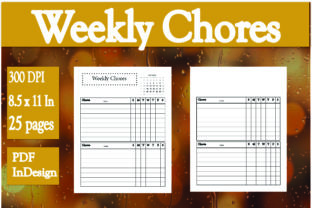
For creators looking to streamline their production process while maintaining high quality, utilizing a comprehensive template package is a strategic advantage. A well-structured resource containing an InDesign file, a ready-to-print PDF file, blank weekly chores tables, and specific technical specifications like 300DPI resolution serves as more than just a shortcut; it is a foundational business asset. Understanding how to leverage these tools effectively can transform a hobbyist project into a scalable publishing enterprise.
Understanding the Low Content Publishing Ecosystem
To fully appreciate the value of a dedicated chores planner template, one must first understand the ecosystem in which it operates. Low content books are publications where the interior consists primarily of repetitive structures, prompts, or organizational frameworks rather than narrative text. Examples include journals, logbooks, trackers, and planners. The "no content" variation takes this further, offering purely structural layouts like graph paper or lined notebooks.
The significance of this business model lies in its accessibility and scalability. Unlike traditional publishing, which demands months of writing and editing, low content publishing focuses on design, utility, and keyword research. However, a common misunderstanding among beginners is that "low content" means "low effort." In reality, successful products solve specific problems. A generic notebook faces immense competition, but a specialized Weekly Chores Planner targets a distinct audience seeking organization for household management, family responsibilities, or personal productivity.
This is where professional templates bridge the gap between idea and execution. By providing pre-formatted dimensions (8.5 x 11 inches) and industry-standard resolution (300DPI), a quality template ensures that the final product meets the rigorous printing standards of platforms like Amazon KDP or IngramSpark, eliminating technical rejections and ensuring customer satisfaction.
The Practical Relevance of Household Organization Tools
Why do consumers continue to buy physical chore planners in an era of digital apps? The answer lies in cognitive load and tangible accountability. Digital fatigue is a genuine modern challenge; many families and individuals prefer a physical interface for managing recurring tasks because it reduces screen time and provides a visual anchor in shared living spaces.
A Weekly Chores Planner serves several practical functions that make it a staple in the low content market:
- Visual Management: Blank weekly tables allow users to see their entire week at a glance, facilitating better time blocking and task distribution.
- Family Collaboration: Physical planners placed on refrigerators or bulletin boards encourage communication among family members without requiring everyone to sync devices.
- Customization: Unlike rigid apps, blank templates allow users to define their own categories, whether for cleaning, meal prep, homeschooling, or pet care.
- Habit Formation: The act of physically checking off a box reinforces behavioral psychology principles related to habit tracking and dopamine reward loops.
When you offer a product that includes 25 pages of varied layouts, you are not just selling paper; you are selling a system for domestic peace and efficiency. This emotional and practical utility is what drives sales and positive reviews, which are critical for SEO and algorithmic visibility in online marketplaces.
Leveraging Technical Assets for Business Efficiency
For the publisher, the technical composition of the product is just as important as its end-user utility. A robust template package designed for the low content business typically includes multiple file formats to accommodate different skill levels and workflows. Understanding these components is essential for maximizing your return on investment.
The InDesign File: Adobe InDesign remains the industry standard for layout design. Having access to the source .indd file allows experienced designers to modify margins, adjust grid systems, change fonts, or rebrand the planner entirely. This flexibility is crucial for creating unique variations of the same base product, preventing market saturation within your own portfolio. It also allows for the correction of any bleed or safety zone issues before publication.
The PDF File: For those who do not own expensive design software or lack advanced technical skills, a high-resolution PDF is invaluable. It serves as a print-ready interior that can be uploaded directly to publishing platforms. This lowers the barrier to entry significantly, allowing new entrepreneurs to test the market viability of a Weekly Chores Planner without upfront design costs.
Resolution and Dimensions: The specification of 300DPI (dots per inch) at 8.5 x 11 inches is non-negotiable for professional printing. Screens display images at 72 or 96 DPI, which looks crisp digitally but appears pixelated and blurry when printed. Ensuring your assets are 300DPI guarantees crisp lines and legible text, which directly impacts perceived value and customer retention.
Strategic Integration into Modern Creative Workflows
Incorporating a pre-made planner template into your business strategy aligns with modern principles of lean entrepreneurship. Rather than spending dozens of hours drawing table grids from scratch, creators can focus on the aspects of the business that actually generate revenue: keyword research, cover design, marketing, and brand building.
Consider the inclusion of calendar elements, such as a 2021 calendar reference or perpetual dating systems. While specific years date a product, they also capture immediate search intent. A savvy publisher uses the included calendar pages as a bonus feature or adapts them into undated versions to extend the product's shelf life indefinitely. This duality maximizes the asset's longevity.
Furthermore, these templates serve as educational tools for aspiring publishers. By deconstructing a professionally designed InDesign file, beginners can learn about master pages, paragraph styles, and binding margins. This reverse-engineering process accelerates the learning curve, helping creators develop the skills necessary to eventually design original products from scratch.
Common Misunderstandings in Low Content Publishing
Despite the apparent simplicity, there are pitfalls that new publishers often encounter. Addressing these through proper tool usage is key to long-term success.
- Assuming Interiors Don't Matter: Many believe only the cover sells the book. While the cover attracts clicks, the interior generates reviews. Using a professional template with clean alignment and adequate whitespace prevents the "amateur" look that leads to returns.
- Ignoring Bleed and Margins: Printers require specific safety zones. A template pre-set to 8.5 x 11 with correct bleeds eliminates the guesswork and prevents content from being trimmed off during manufacturing.
- Oversaturating Without Differentiation: Simply uploading a stock template without modification can lead to duplicate content flags. The inclusion of editable source files encourages customization, ensuring your version of the Weekly Chores Planner remains unique and compliant with platform terms of service.
- Neglecting Niche Specificity: A "chores planner" is broad. Successful publishers use the blank tables to create niche variants: "ADHD Cleaning Planner," "Post-Surgery Recovery Tracker," or "Airbnb Host Maintenance Log." The template provides the structure; your creativity provides the market fit.
Building a Sustainable Portfolio
Ultimately, a product featuring blank weekly chores tables, high-resolution files, and editable sources is a catalyst for business growth. It represents a shift from trading time for money to investing in scalable assets. Whether you are a seasoned designer looking to expand your catalog or a novice testing the waters of self-publishing, the right tools make the difference between frustration and profitability.
By focusing on quality, usability, and technical precision, you honor the E-E-A-T principles (Experience, Expertise, Authoritativeness, and Trustworthiness) that search engines and customers alike prioritize. You demonstrate expertise by providing a flawless user experience, authority by adhering to professional print standards, and trustworthiness by delivering exactly what was promised. In the competitive landscape of low content publishing, these qualities are the true drivers of sustainable success.
The Weekly Chores Planner is more than a collection of pages; it is a case study in effective product development. By understanding its components—from the 300DPI resolution to the versatile InDesign files—you equip yourself with the knowledge to navigate the broader world of digital publishing. Start with a strong foundation, customize with intention, and build a business that brings order to both your customers' lives and your own creative journey.