KDP Smiley Face Alphabet Pages for Coloring Books
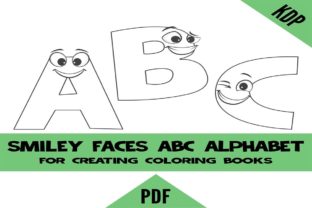
Creating a successful low-content book on Amazon requires more than just assembling generic clip art; it demands a cohesive theme that resonates with both the buyer and the end user. For publishers targeting the early education market, KDP Smiley Face Alphabet Coloring Pages offer a specialized solution that bridges literacy learning with emotional intelligence. This specific resource provides 26 unique PDF pages in standard 8.5 x 11 format, where every letter from A to Z is paired with a distinct facial expression ranging from happy and excited to sad, upset, or sick. Rather than offering repetitive imagery, this variation allows creators to design coloring books that serve a dual educational purpose, making them particularly valuable for homeschooling curriculums and distance learning environments.
Integrating Emotional Learning with Literacy
The primary advantage of using these specific alphabet sheets lies in their ability to support Social-Emotional Learning (SEL) alongside traditional phonics. In the current educational landscape, parents and educators are actively seeking materials that do more than teach letter recognition. By utilizing KDP Smiley Face Alphabet Coloring Pages that feature diverse emotions, you enable children to associate letters with feelings. For example, associating the letter "S" with a "sick" face or "E" with an "excited" expression creates a mnemonic device that reinforces vocabulary beyond simple object association.
This approach adds significant value to your published book. When a parent browses Amazon for ABC coloring books, they are often comparing dozens of similar options. A book that explicitly mentions emotional development in its description and demonstrates varied expressions in the "Look Inside" feature stands out as a thoughtful educational tool rather than a generic activity pad. The inclusion of nuanced emotions like "upset" or "sad" also opens opportunities for discussion during coloring time, transforming a passive activity into an interactive learning moment about empathy and self-regulation.
Streamlining Production for KDP Publishers
For entrepreneurs and freelancers managing multiple titles, efficiency is paramount. Sourcing individual images for 26 letters while maintaining a consistent artistic style can be time-consuming and expensive. These pre-formatted PDF sheets solve the consistency problem instantly. Because the artwork is designed as a unified set, the visual flow of your final book remains professional from start to finish. The 8.5 x 11 dimensions match the most popular trim size for KDP coloring books, eliminating the need for resizing or reformatting that can sometimes degrade image quality or alter margins.
Having the files in PDF format further simplifies the workflow. You can compile the 26 pages directly into your manuscript or use them as a base layer to add additional design elements such as tracing lines, word puzzles, or journaling prompts. This flexibility allows you to create a thicker, higher-value book without commissioning custom illustrations for every single page. For marketers and small business owners testing new niches, this reduces the upfront risk and time-to-market, allowing for faster validation of whether an emotion-based alphabet book resonates with your specific audience.
Practical Applications in Homeschooling and Distance Learning
Educators and homeschooling parents represent a significant portion of the buyer demographic for KDP coloring books. Understanding their specific needs helps in positioning your product effectively. In distance learning scenarios, teachers often require printable resources that can be easily distributed digitally or used independently by students at home. The clear, bold lines typical of smiley face alphabet designs reproduce well on standard home printers, which is a critical technical consideration for this audience.
When designing your book interior, consider how these pages function in a lesson plan. The unique faces provide natural prompts for writing or speaking exercises. A teacher might ask a student to color the "happy" face and then draw something that makes them feel that way, or to identify which letter corresponds to feeling "upset." By highlighting these use cases in your book’s description or back matter, you signal to educators that this resource was created with pedagogical intent. This alignment with real-world teaching strategies improves the perceived utility of the book and can lead to better reviews and organic visibility.
Considerations for Customization and Compliance
While KDP Smiley Face Alphabet Coloring Pages provide an excellent foundation, successful publishers understand the importance of differentiation. Amazon’s marketplace is competitive, and simply uploading the raw PDF pages may not be sufficient to capture long-term sales. Consider using these sheets as core content while adding unique value through supplementary pages. You might include a "Feelings Chart" at the beginning, certificate of completion at the end, or blank practice pages between letters to increase the page count and perceived value.
It is also vital to verify licensing terms before publication. Ensure that the specific package you acquire grants full commercial rights for KDP distribution. Some digital assets are restricted to personal use only, and violating these terms can result in account suspension. Additionally, while the 26 pages cover the alphabet, a viable coloring book typically requires at least 40 to 50 pages to justify a price point that covers printing costs and generates royalties. Plan your layout strategy accordingly, perhaps by placing the coloring page on the right and a related activity or blank backing page on the left to prevent bleed-through and enhance the user experience.
Targeting the Right Audience Segments
Different segments of the 20–50 age demographic will utilize these resources differently, and your marketing should reflect this nuance. Freelancers and hobbyists entering the KDP space often look for low-barrier entry points; for them, the ready-made nature of these smiley face pages removes the illustration hurdle entirely. Conversely, established publishers or educators may use them as part of a larger curriculum bundle. Recognizing these distinct motivations helps in crafting metadata and ad copy that speaks directly to the buyer's goal.
For content creators and bloggers who also sell digital products, these alphabet pages can serve as lead magnets or bonus content to drive traffic to their KDP listings. Offering a free sample page featuring a specific emotion can build an email list of parents interested in SEL resources. This cross-channel strategy leverages the versatility of the PDF format, extending the value of the asset beyond the Amazon ecosystem. Whether you are a solo creator building a passive income stream or an educator supplementing classroom materials, the key is to view these pages not just as images, but as components of a broader educational solution.
Evaluating Fit and Limitations
Despite their versatility, KDP Smiley Face Alphabet Coloring Pages are not a universal fit for every project. If your brand focuses on realistic anatomy, complex scenes, or advanced artistic techniques, simplified smiley faces may alienate your target audience. Similarly, if you are targeting older children or adults, this aesthetic may appear too juvenile. It is essential to align the visual style with the developmental stage of your intended user. Always review the actual line weight and complexity of the faces before purchasing or publishing; some styles may be too thin for crayons or too detailed for toddlers.
Furthermore, reliance solely on pre-made assets can limit brand distinctiveness over time. As you scale, consider investing in custom variations or hiring illustrators to expand upon the smiley face concept with proprietary characters. Use these PDF sheets as a proof-of-concept or a gap-filler while developing unique intellectual property. This balanced approach allows you to maintain publishing momentum today while building defensible assets for tomorrow. Ultimately, the success of your coloring book depends on how thoughtfully you integrate these resources into a product that genuinely serves the learning and creative needs of children.